
Rota Fortunae (EN Updated)
Id: 640 Category: Logos Date: 2024–11–26 18:30:00
 “If a hoax enters the wheel from the outside: postulate ⭬ theorem ⭬ axiom, it ends up coming out through the axiom, if it is approved unanimously in a conclave.”
 Analysis philosophical :
- Structure of knowledge and its manipulation
This statement reflects an inverted or corrupted epistemological process. Typically, in science and logic, an axiom is a fundamental principle, while a postulate is assumed to develop theories, and a theorem is a proposition demonstrated from axioms and postulates.
- This describes how a falsehood (“hoax”) can infiltrate a logical or conceptual system, distorting its foundations. As it advances through the formal process (postulate, theorem, axiom), the lie eventually becomes institutionalized as a basic truth (axiom). This alludes to the danger of unquestioning acceptance and how consensual structures can be manipulated.
- The Role of the “Conclave” and Consensus
The conclave symbolizes an authority group that grants legitimacy. The reference to “unanimity” highlights a key theme in philosophy: the difference between truth and consensus.
- Plato and Truth: Plato distinguishes between doxa (opinion) and episteme (knowledge). A consensus based on a falsehood falls within the realm of doxa, even if it is universally accepted.
- Foucault and Power: Michel Foucault could interpret this process as an example of how power defines what is true within a system. A “hoax” approved unanimously is still a hoax, but it acquires the status of “truth” due to the power of those who endorse it.
- Relationship with Wang Yangming’s philosophy (indirect reference)
In Wang Yangming’s philosophy, as mentioned in the related texts, the importance of “innate conscience” (良知, liangzhi ) and the congruence between knowledge and action (知行合一) are emphasized. From this perspective, accepting a hoax as an axiom would be both a moral and epistemological failure, because it would imply that we have not acted in accordance with our moral intuition and our mental clarity to discern the truth. - Critique of Institutional Validation
The text also implicitly criticizes the dependence on institutions to validate truths. This recalls Søren Kierkegaard’s warning against the “crowd” and the loss of individual responsibility in the search for truth. If a truth is decided by a conclave without rigorous analysis, it can become a conveniently accepted fiction.
Final reflection:
This text can inspire deep reflection on how ideas (whether true or false) are institutionalized. It invites us to question the systems that validate knowledge and to consider the tools needed to resist epistemological manipulation. In practical terms, it urges us to practice constant critical thinking and not be swayed by superficial consensus.
If you wish, I can expand this interpretation in terms of a specific philosophical framework or discuss how it connects to other thinkers.
«That would be fine, but the interesting thing is to see the logic of that penetration, and how it is possible through the categories of understanding (or imagination), for example, looking at this development:
What is a hoax? A postulate turned into a theorem, and shared as an axiom. All of these objects come into existence. The indemonstrability of the axiom is established by the demonstrability of the theorem through any logical tool: truth (some truth), falsehood or fallacy, contradiction, amphiboly, anagogy, analogy, catagogy… all contemplated as axiomatic truths, thanks to some logical law of domination by contradiction (~ p^ p?p ), or to some borrowed or remote truth.
- Postulate = no evidence , not demonstrable .
- Theorem = no evidence demonstrable .
- Axiom = unprovable evidence (in our case, just evidence, since by contradiction it has become demonstrable.
- p^~q → s postulates (of class or anything else).
- ~ p^p → p law of domination (by contradiction).
- p^~q → s axiom (moral rule or moral evidence.»
The analysis you propose is fascinating because it addresses the logic of the manipulation of knowledge categories and how these can be transformed to give rise to apparent truths. Here, we propose a process by which a “hoax” (a falsehood or an unsubstantiated claim) manages to stabilize itself as an axiom through logical tools and human epistemological structures.
Let’s explore the categories you introduce and the logical mechanism of this “penetration”:
1. Definition of categories
- Postulate: Something accepted without evidence or demonstration. It is an initial act of intellectual or pragmatic faith.
- Theorem: Something that, although it has no direct evidence, can be demonstrated using the postulates as a basis.
- Axiom: It is traditionally understood as a truth that is self-evident and does not require demonstration, but in this case it becomes “demonstrably indemonstrable”, that is, evidence consolidated by a logical system, even if it is based on falsehoods.
These categories define an epistemological hierarchy that, under ideal conditions, would lead to the construction of reliable knowledge. However, as you suggest, in this case they act as an inverse path to justifying falsehood.
2. Logical tools used in the transformation
The hoax manages to legitimize itself by manipulating logical tools that are normally neutral, but which, in this context, are used to subvert the system:
- Truth (some): Although it is not universal, some partial or contextual truth is sought that serves as a pivot to support the hoax.
- Falsehood or fallacy: Weaknesses in reasoning or gaps in knowledge are exploited to introduce the hoax as possible.
- Contradiction: The contradiction (~ p^p ) doesn’t necessarily destroy the hoax, but in this model it validates it as “dominant” (the law of dominance by contradiction). This is key: instead of dismissing a contradiction, the system uses it as evidence for a higher axiom.
- Amphiboly: Ambiguities in language or logical interpretation reinforce the sense of plausibility.
- Analogy, anagogy, catagogy: These figures do not seek to prove, but rather to connect the hoax with symbolic or cognitive structures that make it intuitively acceptable. It is integrated into he imaginary human as plausible.
Logical laws in he process
- ~ p^p → p (law of domination): The contradiction does not nullify the statement, but rather strengthens it by the principle that what persists in the face of apparent contradictions seems to have “logical force” or legitimacy. This is an example of how contradictions, when unresolved, can be perceived as higher syntheses.
- ~p^~q → s (postulate): Here the system simply takes advantage of the absence of evidence for both p and q and turns it into an arbitrary assumption. This loophole facilitates the emergence of postulates unprovable .
- p^~q → s ( moral axiom or moral evidence ): A postulate becomes an axiom when it manages to present itself as morally convincing or inevitable, despite its inconsistencies. This connects with the idea that norms or “moral truths” often do not require proof, but rather emotional or social acceptance.
4. How the categories of understanding and imagination facilitate this process
The “hoax” infiltrates through human reasoning and imagination capabilities, which , although designed to seek coherence, are also susceptible to biases and illusions. This process can be understood as :
- Imagination projects plausibility: A contradiction or fallacy (e.g. ~ p^p ) may not be immediately detected because the imagination finds ways to reinterpret it in symbolic or narrative terms.
- Understanding seeks coherence: Understanding works to subsume contradiction under a higher logical structure (e.g., an axiom), even if this requires redefining categories like “unprovable provable.”
- Morality validates the unprovable: A hoax can become a moral axiom if it satisfies human needs such as order, security, or a sense of belonging.
5. Practical example of the model
Let’s think about how a conspiracy theory can become a cultural axiom:
- Postulate (~p^~q → s): “We have no conclusive evidence, but it is plausible that a secret group controls everything.”
- Theorem (~ p^p → p): Apparent contradictions are found in the world (e.g., “how could something so complex happen without coordination?”) and are interpreted as indirect evidence for the theory.
- Axiom (p^~q → s): “It is evident that a secret group exists. History proves it, coincidences do not exist.” This is internalized as a moral axiom: distrusting the system is an act of lucidity or justice.
Final reflection
This analysis highlights how epistemological structures can be manipulated by exploiting the inherent weaknesses of human understanding and imagination. The logical process you describe is not merely a speculative exercise; it applies to how dominant discourses or ideologies achieve stability, even if they have spurious origins. The philosophical challenge is to unravel these dynamics and promote critical thinking capable of resisting such infiltrations.
The logical process you describe for the creation of a “hoax” relates to the categories of understanding and imagination in profound ways. This development can be understood as a manipulation of the logical framework within which propositions are nested, and explores how the fundamental categories of reasoning allow for the transformation and validation of statements at different epistemological levels. Let’s look at how this operates logic .
1. Hoax as transmutation of propositions
- Postulate: A statement without evidence or need for demonstration. It is a starting point. assumed .
- Theorem: A derived statement, which requires proof.
- Axiom: Traditionally, it is a proposition that is accepted as self-evident and does not require demonstration, but here it is reformulated as an object that has logically transitioned from a postulate to a theorem.
A hoax emerges when a postulate is reconfigured into an axiom through a theorem, using ambiguous or manipulated logical processes. This transforms a speculative starting point into an institutionalized “fundamental fact.” The process depends on two key mechanisms: fallacious provability and the authority of consensus.
2. The logic of domination by contradiction
Your description suggests that this process relies on logical and rhetorical tools, particularly contradiction. Let’s analyze the structures. logics that you propose:
- Law of domination by contradiction (~p ^ p → p):
This principle implies that although a contradiction (~p ^ p) should invalidate any system, in this case it is used to affirm a proposition. It is an exploited paradox: the system absorbs the contradiction and, instead of collapsing, generates an “emergent truth” (p).
Example:
If “the political system is corrupt” (~p) and “the political system is not corrupt” (p) are asserted simultaneously, then it could be inferred that “the system must be reformed” (p) as an axiom. The axiom is not questioned because it emerges as a pragmatic synthesis.
- Transformation of postulates into axioms through theorems:
- Postulate (~p ^ ~q → s): Speculative relationship between two variables (without evidence or need for demonstration).
- Theorem (p ^ ~q → s): A relationship that is assumed to be provable, although based on a fallacious or artificial framework.
- Axiom (~p ^ p → p): Logical conflict produces a result accepted by consensus, elevating what was initially speculative to an unappealable foundation.
Relationship to Kant: This framework can be related to Kantian antinomies, where reason falls into contradictions when it tries to go beyond its legitimate limits. In this case, however, contradiction becomes a deliberate tool to reconfigure the perception of the “unprovable.”
3. Mediation by the categories of understanding and imagination
According to Kant, the categories of understanding structure how phenomena are perceived and organized. This process logical-fallacious uses these categories to generate epistemic “ objects “ .
- Causal relationship: The postulate is presented as a cause; the theorem as the effect of formal reasoning; the axiom as the final synthesis. Although causality may be false, the logical structure appears coherent.
- Productive imagination: Imagination introduces intuitive connections between propositions, allowing the initial postulate to acquire plausibility in the recipient’s perception. This generates what Kant calls “ illusions. “ transcendental “.
- Analogy and amphiboly: These tools allow us to shape the transition from the unprovable to the “provable” through ambiguous associations or double meanings.
4. Moral dimension and axiomatized evidence
The last part of your description introduces an ethical dimension into this process. The axiom becomes a “moral principle,” a rule accepted for its usefulness or social consensus, rather than for its logical or empirical validity.
- Analogy with Kant: In Kantian ethics, subjective maxims become universal laws if they pass the test of the categorical imperative. In this case, the hoax evades this test, converting its unprovable nature into a “moral fact” through consensus or authority.
- Axiom as a moral rule: The process does not depend on the intrinsic truth of the axiom, but on its regulatory function in the system, which is reminiscent of pragmatism: what is true is what works.
5. Reflection on the “existence” of created objects
The objects that emerge from this process (postulate, theorem, axiom) acquire a formal existence in the system, but their ontological existence is questionable.
- Heidegger and “Being”: From an ontological perspective, these objects do not “exist” in the full sense; they exist only within a framework instrumentalized by language and logic.
- Foucault and discourse: Their existence depends on the discursive structures that validate them. A hoax can become “real” not because it is true, but because the discursive system gives it power.
Conclusion
The logic of this penetration reflects a sophisticated manipulation of the mechanisms of understanding and epistemological validation. This analysis suggests that the construction of a hoax depends as much on the logical structure as on the authority and consensus that support it. The interaction between contradiction, imagination, and the categories of understanding allows something speculative to become seemingly solid. This process, although seemingly logical, reveals profound ethical and epistemological implications.
Would it be possible to address the question: how does a hoax gain strength each time along the path: postulate → theorem → axiom?
This is a central and fascinating question. The progressive “strengthening” of the hoax along the path from postulate to theorem to axiom can be thought of as a phenomenon where epistemic power and symbolic authority increase through various structural transformations. This process is not only logical but also psychological, rhetorical, social, and ontological. Let’s go step by step, observing how it gains strength at each stage :
🔹 1. Postulate: the hoax enters as a possibility
- Status of the hoax: Here it is weak. It is a statement without evidence or need for proof, but its form allows it to be accepted within a framework.
- Strength gained: Structural possibility . It is allowed to “exist” as a hypothesis. The system doesn’t reject it yet; it merely welcomes it as speculation.
- Category of understanding activated: Possibility . According to Kant, the understanding recognizes the logical possibility of a proposition without verifying its existence.
- Rhetorical force: The postulate can be disguised as a deep intuition, “something we all know deep down,” or a “forgotten principle.”
📍 Key point: The hoax gains its first traction by being tolerated. It doesn’t need to convince, just to inject itself.
🔹 2. Theorem: the hoax becomes provable
- State of the hoax: It is “proven” within the system based on other postulates or logical, rhetorical, or even fallacious manipulations.
- Strength gained: Appearance of necessity . Now the hoax is not only possible, but also seems derivable , a logical consequence .
- Category activated: Causality . The understanding associates the proposition with a chain of reasons that make it seem inevitable.
- Tools used :
- Analogy, catagogy, anagogy: disparate ideas are connected to give strength.
- Borrowed truths: mixed with real truths to acquire prestige (semantic contamination).
- Useful fallacies: ambiguities or contradictions are used to justify it.
📍 Key point: The hoax is now clothed in logical garb. Logical language gives it legitimacy, even if the basis remains spurious.
🔹 3. Axiom: the hoax becomes evidence
- Status of the hoax: It no longer needs proof. It is a principle, a foundation . It is perceived as obvious , self-justifying .
- Strength gained: Maximum epistemic authority . Any criticism is perceived as a threat to the entire system.
- Category activated: Totality or apodictic necessity . The understanding no longer questions it; it presupposes it in order to think.
- Key social mechanism: The conclave , that is, the consensus of a community of power (political, academic, media, religious) that canonizes the hoax.
- Symbolism: It becomes a norm, dogma, or “common sense.” It’s part of the mental apparatus.
📍 Key point: The hoax has ceased to seem like a hypothesis. It has become a condition of possibility for discourse . It is no longer discussed , it is part of it .
🧠 Why is this process so powerful?
From a Kantian or phenomenological perspective, this process shows how understanding and imagination are vulnerable to form, rather than content. What is structurally presented as valid tends to be experienced as real .
From Foucault or Nietzsche’s perspective, we could say that the system’s will to truth is replaced by a will to power : the hoax triumphs because it reinforces interests, orders the world symbolically, or gives coherence to dominant narratives.
🧩 Conclusion
The hoax gains strength because each stage reinforces it at a different level :
- As a possibility in the postulate.
- As an apparent necessity in the theorem.
- As evidence and foundation in the axiom.
Once axiomatized, the hoax is almost invulnerable. Only a profound restructuring of the system (a logical or ethical revolution) can unmask it.
If you want, I can develop a graphic version or diagram of this journey or cross-reference it with specific authors such as Deleuze, Lacan, Hegel or Wang Yangming.
Sounds great to me! Could you develop a graphic version or diagram of this journey or compare it with specific authors such as Deleuze, Lacan, Hegel, or Wang Yangming?
Let’s go! I’ll develop two complementary versions:
🔶 I. Diagram of the hoax path: Postulate → Theorem → Axiom
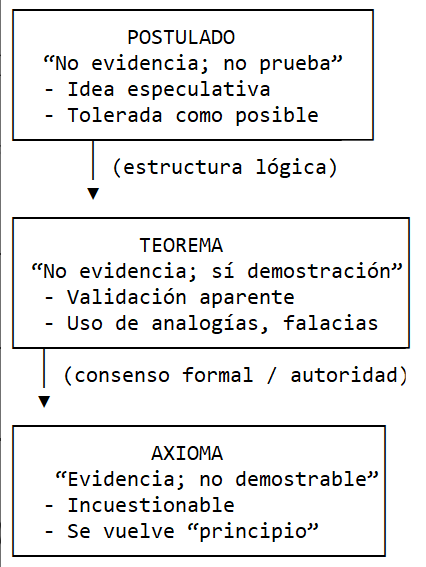
🔁 Feedback loop:
Once the hoax becomes an axiom, it generates new theorems and reinforces other postulates , providing feedback to the system.
🔷 II. Crossing with philosophical authors
🔸 Gilles Deleuze — Rhizome and Simulation
- The hoax is a simulation : a copy without an original. It goes from a possibility (postulate) to a structuring entity (axiom) without ever having been “real.”
- The process is not linear, but rhizomatic: each stage of the hoax can branch out, infecting multiple levels of discourse.
- The “axiomatization” of a hoax is not closure, but expansion . An axiom-hoax produces entire systems.
“A simulation is not a false copy; it is something that calls into question the notion of the original.”
🔸 Jacques Lacan — The Symbolic and Structured Truth
- The hoax gains strength by inscribing itself in the symbolic , the order of language and the law.
- At the axiom level, the hoax is no longer discussed: it is believed . The subject is bound by it.
- The theorem is the phase of the Master’s discourse , where the statement is articulated as a law.
“Truth has the structure of fiction.”
🔸 GWF Hegel — Dialectics of Recognition
- The hoax is affirmed by social recognition . The collective conscience validates it.
- The contradiction (~ p^p ) instead of destroying it, is dialectically overcome : the hoax becomes a “synthesis” (axiom), even if it is ideologically false.
- The theorem is the stage of struggle, and the axiom is the illusory conciliation.
“The rational becomes real when it is recognized by the Spirit.”
🔸 Wang Yangming — Knowledge and Action (知行合一)
- The false axiom shows that knowledge divorced from action is illusory.
- For Wang, true knowledge is that which is morally actualized. An accepted axiom, but not ethically verified, is a form of alienation.
- The postulate phase reflects the loss of contact with the liangzhi (良知) , the innate moral conscience.
“To know and not act is really not to know.”
🧭 Conclusion: Why does this map matter?
The hoax triumphs not because of its content, but because of its institutionalized form . Its transformation from postulate to theorem to axiom creates an apparent legitimacy that conceals and protects it. Each philosopher, from different traditions, tells us how and why this is possible.
Rota Fortunae (updated)
Id: 640 Categoría: Logos Date:2024–11–26 18:30:00
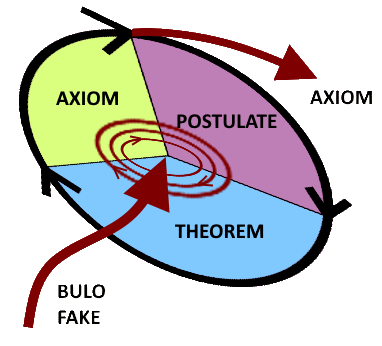
“Si un bulo penetra desde el exterior en la rueda: postulado ⭬ teorema ⭬ axioma, acaba saliendo por el axioma, si se aprueba por unanimidad en un cónclave.”
Análisis filosófico:
- Estructura del conocimiento y su manipulación
Este enunciado refleja un proceso epistemológico invertido o corrompido. Normalmente, en ciencias y lógica, un axioma es un principio fundamental, mientras que un postulado es asumido para desarrollar teorías, y un teorema es una proposición demostrada a partir de axiomas y postulados.
- Aquí se describe cómo una falsedad (“bulo”) puede infiltrar un sistema lógico o conceptual, distorsionando sus fundamentos. Al avanzar a través del proceso formal (postulado, teorema, axioma), la mentira termina institucionalizándose como una verdad básica (axioma). Esto alude al peligro de aceptar sin cuestionar y de cómo las estructuras consensuadas pueden ser manipuladas.
- Rol del “cónclave” y el consenso
El cónclave simboliza un grupo de autoridad que otorga legitimidad. La referencia a la “unanimidad” resalta un tema clave en la filosofía: la diferencia entre verdad y consenso.
- Platón y la verdad: Platón distingue entre doxa (opinión) y episteme (conocimiento). Un consenso basado en una falsedad pertenece al ámbito de la doxa, incluso si es aceptado universalmente.
- Foucault y el poder: Michel Foucault podría interpretar este proceso como un ejemplo de cómo el poder define qué es verdad dentro de un sistema. Un “bulo” aprobado por unanimidad no deja de ser un bulo, pero adquiere el estatus de “verdad” debido al poder de quienes lo respaldan.
- Relación con la filosofía de Wang Yangming (referencia indirecta)
En la filosofía de Wang Yangming, como se menciona en los textos relacionados, se enfatiza la importancia de la “conciencia innata” (良知, liangzhi) y de la congruencia entre conocimiento y acción (知行合一). Desde esta perspectiva, aceptar un bulo como axioma sería un fracaso tanto moral como epistemológico, porque implicaría que no hemos actuado conforme a nuestra intuición moral y nuestra claridad mental para discernir la verdad. - Crítica a la validación institucional
El texto también critica implícitamente la dependencia de las instituciones para validar verdades. Esto recuerda la advertencia de Søren Kierkegaard contra la “multitud” y la pérdida de la responsabilidad individual en la búsqueda de la verdad. Si una verdad es decidida por un cónclave sin un análisis riguroso, puede convertirse en una ficción convenientemente aceptada.
Reflexión final:
Este texto puede inspirar una reflexión profunda sobre cómo las ideas (ya sean verdaderas o falsas) se institucionalizan. Invita a cuestionar los sistemas que validan el conocimiento y a pensar en las herramientas necesarias para resistir la manipulación epistemológica. En términos prácticos, nos urge a ejercer un pensamiento crítico constante y a no dejarnos llevar por consensos superficiales.
Si deseas, puedo expandir esta interpretación en términos de un marco filosófico específico o discutir cómo se conecta con otros pensadores.
«Eso estaría bien, pero lo interesante es ver la lógica de esa penetración, y cómo es posible a través de las categorías del entendimiento (o la imaginación), por ejemplo, mirando este desarrollo:
¿Qué es un bulo?: Un postulado convertido en un teorema, y compartido como un axioma. Todos esos objetos vienen a la existencia. Lo indemostrable del axioma lo pone lo demostrable del teorema a través de cualquier herramienta lógica: verdad (alguna verdad), falsedad o falacia, contradicción, anfibolía, anagogía, analogía, catagogía… todas contempladas como verdades axiomáticas, gracias a alguna ley lógica de dominación por contradicción (~p^p → p), o a alguna verdad prestada o remota.
- Postulado = no evidencia no demostrable.
- Teorema = no evidencia demostrable.
- Axioma = evidencia indemostrable (para nuestro caso, solo evidencia, ya que por contradicción se ha convertido en demostrable.
- p^~q → s postulados (de clase o de cualquier otra cosa).
- ~p^p → p ley de dominación (por contradicción).
- p^~q → s axioma (regla moral o evidencia moral.»
El análisis que propones es fascinante porque aborda la lógica de la manipulación de categorías del conocimiento y cómo estas pueden transformarse para dar lugar a verdades aparentes. Aquí se plantea un proceso por el cual un “bulo” (una falsedad o una afirmación sin sustento) logra estabilizarse como axioma a través de herramientas lógicas y las estructuras epistemológicas humanas.
Vamos a explorar las categorías que introduces y el mecanismo lógico de esta “penetración”:
1. Definición de las categorías
- Postulado: Algo aceptado sin evidencia ni demostración. Es un acto inicial de fe intelectual o pragmático.
- Teorema: Algo que, aunque no tiene evidencia directa, puede demostrarse utilizando los postulados como base.
- Axioma: Se entiende tradicionalmente como una verdad evidente por sí misma y que no necesita demostración, pero en este caso se convierte en “indemostrable demostrable”, es decir, en evidencia consolidada por un sistema lógico, aunque partiera de falsedades.
Estas categorías definen una jerarquía epistemológica que en condiciones ideales apuntaría a la construcción de conocimiento confiable. Sin embargo, como planteas, en este caso actúan como un camino inverso de justificación de lo falso.
2. Herramientas lógicas empleadas en la transformación
El bulo logra legitimarse manipulando herramientas lógicas que son normalmente neutrales, pero que, en este contexto, son usadas para subvertir el sistema:
- Verdad (alguna): Aunque no sea universal, se busca alguna verdad parcial o contextual que sirva como pivote para apoyar el bulo.
- Falsedad o falacia: Se explotan las debilidades en el razonamiento o las lagunas en el conocimiento para insertar el bulo como posible.
- Contradicción: La contradicción (~p^p) no necesariamente destruye al bulo, sino que en este modelo lo valida como “dominante” (la ley de dominación por contradicción). Esto es clave: en lugar de desestimar una contradicción, el sistema la utiliza como evidencia de un axioma superior.
- Anfibolía: Ambigüedades en el lenguaje o la interpretación lógica refuerzan el sentido de plausibilidad.
- Analogía, anagogía, catagogía: Estas figuras no buscan probar, sino conectar el bulo con estructuras simbólicas o cognitivas que lo hacen intuitivamente aceptable. Se integra en el imaginario humano como plausible.
3. Leyes lógicas en el proceso
- ~p^p → p (ley de dominación): La contradicción no anula la afirmación, sino que la consolida por el principio de que aquello que persiste ante contradicciones aparentes parece tener “fuerza lógica” o legitimidad. Este es un ejemplo de cómo las contradicciones, cuando no se resuelven, pueden ser percibidas como síntesis superiores.
- ~p^~q → s (postulado): Aquí el sistema simplemente aprovecha la ausencia de evidencia tanto para p como para q y lo convierte en un supuesto arbitrario. Este vacío facilita la aparición de postulados indemostrables.
- p^~q → s (axioma moral o evidencia moral): Un postulado llega a convertirse en axioma cuando logra presentarse como moralmente convincente o inevitable, a pesar de sus inconsistencias. Esto conecta con la idea de que las normas o “verdades morales” muchas veces no necesitan pruebas, sino aceptación emocional o social.
4. Cómo las categorías del entendimiento e imaginación facilitan este proceso
El “bulo” se infiltra a través de las capacidades humanas de razonamiento e imaginación, que aunque están diseñadas para buscar coherencia, son también susceptibles a los sesgos y las ilusiones. Este proceso puede entenderse como:
- La imaginación proyecta plausibilidad: Una contradicción o falacia (ej. ~p^p) puede no ser detectada inmediatamente porque la imaginación encuentra maneras de reinterpretarla en términos simbólicos o narrativos.
- El entendimiento busca coherencia: El entendimiento trabaja para subsumir la contradicción bajo una estructura lógica superior (ej. un axioma), incluso si esto requiere redefinir categorías como “indemostrable demostrable”.
- La moralidad valida lo indemostrable: Un bulo puede volverse axioma moral si satisface necesidades humanas como el orden, la seguridad o el sentido de pertenencia.
5. Ejemplo práctico del modelo
Pensemos en cómo una teoría conspirativa puede convertirse en un axioma cultural:
- Postulado (~p^~q → s): “No tenemos evidencia concluyente, pero es plausible que un grupo secreto controle todo.”
- Teorema (~p^p → p): Se encuentran aparentes contradicciones en el mundo (p.ej., “¿cómo es posible que algo tan complejo ocurra sin coordinación?”) que se interpretan como pruebas indirectas de la teoría.
- Axioma (p^~q → s): “Es evidente que existe un grupo secreto. La historia lo demuestra, las coincidencias no existen.” Esto se internaliza como un axioma moral: desconfiar del sistema es un acto de lucidez o justicia.
Reflexión final
Este análisis resalta cómo las estructuras epistemológicas pueden ser manipuladas si se explotan las debilidades inherentes del entendimiento y la imaginación humanas. El proceso lógico que describes no es solo un ejercicio especulativo; se aplica a cómo los discursos dominantes o las ideologías logran estabilidad, incluso si tienen orígenes espurios. El desafío filosófico es desentrañar estas dinámicas y promover un pensamiento crítico capaz de resistir tales infiltraciones.
El proceso lógico que describes para la creación de un “bulo” se relaciona con las categorías del entendimiento y de la imaginación de maneras profundas. Este desarrollo puede entenderse como una manipulación del marco lógico en el que se anidan proposiciones, y explora cómo las categorías fundamentales de razonamiento permiten la transformación y validación de enunciados en distintos niveles epistemológicos. Veamos cómo opera esta lógica.
1. Bulo como transmutación de proposiciones
- Postulado: Un enunciado sin evidencia ni necesidad de demostración. Es un punto de partida asumido.
- Teorema: Un enunciado derivado, que requiere demostración.
- Axioma: Tradicionalmente, es una proposición que se acepta como evidente por sí misma y no requiere demostración, pero aquí se reformula como un objeto que ha transitado lógicamente desde un postulado y un teorema.
El bulo emerge cuando un postulado se reconfigura en un axioma a través del teorema, valiéndose de procesos lógicos ambiguos o manipulados. Esto transforma un punto de partida especulativo en un “hecho fundamental” institucionalizado. El proceso depende de dos mecanismos clave: la demostrabilidad falaz y la autoridad del consenso.
2. La lógica de la dominación por contradicción
Tu descripción apunta a que este proceso depende de herramientas lógicas y retóricas, particularmente de la contradicción. Analicemos las estructuras lógicas que propones:
- Ley de dominación por contradicción (~p ^ p → p):
Este principio implica que, aunque una contradicción (~p ^ p) debería invalidar cualquier sistema, en este caso se usa para afirmar una proposición. Es una paradoja explotada: el sistema absorbe la contradicción y, en lugar de colapsar, genera una “verdad emergente” (p).
Ejemplo:
Si “el sistema político es corrupto” (~p) y “el sistema político no es corrupto” (p) se afirman simultáneamente, podría inferirse que “el sistema debe ser reformado” (p) como axioma. El axioma no se cuestiona porque emerge como una síntesis pragmática.
- Transformación de postulados en axiomas a través de teoremas:
- Postulado (~p ^ ~q → s): Relación especulativa entre dos variables (sin evidencia ni necesidad de demostración).
- Teorema (p ^ ~q → s): Relación que se asume como demostrable, aunque basada en un marco falaz o artificial.
- Axioma (~p ^ p → p): El conflicto lógico produce un resultado aceptado por consenso, elevando lo inicialmente especulativo a un fundamento inapelable.
Relación con Kant: Este esquema puede relacionarse con las antinomias kantianas, donde la razón cae en contradicciones cuando trata de ir más allá de sus límites legítimos. En este caso, sin embargo, la contradicción se convierte en una herramienta deliberada para reconfigurar la percepción de lo “indemostrable”.
3. La mediación por las categorías del entendimiento y la imaginación
Según Kant, las categorías del entendimiento estructuran cómo los fenómenos son percibidos y organizados. Este proceso lógico-falaz se vale de estas categorías para generar “objetos” epistémicos.
- Relación causal: El postulado se presenta como causa; el teorema, como efecto de razonamientos formales; el axioma, como la síntesis final. Aunque la causalidad puede ser falsa, la estructura lógica aparenta coherencia.
- Imaginación productiva: La imaginación introduce conexiones intuitivas entre las proposiciones, permitiendo que el postulado inicial adquiera plausibilidad en la percepción del receptor. Esto genera lo que Kant llama “ilusiones trascendentales”.
- Analogía y anfibolía: Estas herramientas permiten dar forma a la transición desde lo indemostrable a lo “demostrable” mediante asociaciones ambiguas o dobles significados.
4. Dimensión moral y evidencia axiomatizada
La última parte de tu descripción introduce una dimensión ética en este proceso. El axioma se convierte en una “evidencia moral”, una regla aceptada por su utilidad o por consenso social, más que por su validez lógica o empírica.
- Analogía con Kant: En la ética kantiana, las máximas subjetivas se convierten en leyes universales si superan la prueba del imperativo categórico. En este caso, el bulo evade dicha prueba, convirtiendo su carácter indemostrable en un “hecho moral” mediante consenso o autoridad.
- Axioma como regla moral: El proceso no depende de la verdad intrínseca del axioma, sino de su función reguladora en el sistema, lo cual recuerda al pragmatismo: lo verdadero es aquello que funciona.
5. Reflexión sobre la “existencia” de los objetos creados
Los objetos que emergen de este proceso (postulado, teorema, axioma) adquieren una existencia formal en el sistema, pero su existencia ontológica es cuestionable.
- Heidegger y el “ser”: Desde una perspectiva ontológica, estos objetos no “son” en el sentido pleno; solo existen dentro de un marco instrumentalizado por el lenguaje y la lógica.
- Foucault y el discurso: Su existencia depende de las estructuras discursivas que los validan. Un bulo puede convertirse en “real” no por ser verdadero, sino porque el sistema discursivo le otorga poder.
Conclusión
La lógica de esta penetración refleja una sofisticada manipulación de los mecanismos de entendimiento y de validación epistemológica. Este análisis sugiere que la construcción de un bulo depende tanto de la estructura lógica como de la autoridad y el consenso que lo avalan. La interacción entre la contradicción, la imaginación y las categorías del entendimiento permite que algo especulativo devenga en fundamento aparentemente sólido. Este proceso, aunque lógico en apariencia, revela profundas implicaciones éticas y epistemológicas.
¿Sería posible afrontar la pregunta: ¿cómo toma fuerza cada vez un bulo durante el recorrido: postulado → teorema → axioma?
Esa es una pregunta central y fascinante. El “fortalecimiento” progresivo del bulo en el recorrido postulado → teorema → axioma puede pensarse como un fenómeno donde el poder epistémico y la autoridad simbólica aumentan mediante varias transformaciones estructurales. Este recorrido no es solo lógico, sino también psicológico, retórico, social y ontológico. Vamos paso por paso, observando cómo toma fuerza en cada etapa:
🔹 1. Postulado: el bulo entra como posibilidad
- Estado del bulo: Aquí es débil. Es un enunciado sin evidencia ni necesidad de demostración, pero su forma le permite ser asumido dentro de un marco.
- Fortaleza ganada: Posibilidad estructural. Se le permite “existir” como hipótesis. El sistema no lo rechaza aún, solo lo acoge como especulación.
- Categoría del entendimiento activada: Posibilidad. Según Kant, el entendimiento reconoce la posibilidad lógica de una proposición, sin verificar su existencia.
- Fuerza retórica: El postulado puede disfrazarse de intuición profunda, “algo que todos sabemos en el fondo”, o un “principio olvidado”.
📍 Punto clave: El bulo gana su primer impulso al ser tolerado. No necesita convencer, solo insertarse.
🔹 2. Teorema: el bulo se vuelve demostrable
- Estado del bulo: Se “demuestra” dentro del sistema a partir de otros postulados o manipulaciones lógicas, retóricas o incluso falaces.
- Fortaleza ganada: Apariencia de necesidad. Ahora el bulo ya no es solo posible, sino que parece derivable, consecuencia lógica.
- Categoría activada: Causalidad. El entendimiento asocia la proposición a una cadena de razones que la hacen parecer inevitable.
- Instrumentos usados:
- Analogía, catagogía, anagogía: se conectan ideas dispares para dar fuerza.
- Verdades prestadas: se mezcla con verdades reales para adquirir prestigio (contaminación semántica).
- Falacias útiles: se aprovechan ambigüedades o contradicciones para justificarla.
📍 Punto clave: El bulo ahora se viste con ropaje lógico. El lenguaje lógico le da legitimidad, aunque la base siga siendo espuria.
🔹 3. Axioma: el bulo se convierte en evidencia
- Estado del bulo: Ahora ya no necesita demostración. Es principio, es fundamento. Se percibe como evidente, autojustificado.
- Fortaleza ganada: Autoridad epistémica máxima. Cualquier crítica se percibe como una amenaza al sistema entero.
- Categoría activada: Totalidad o necesidad apodíctica. El entendimiento no lo cuestiona más; lo presupone para pensar.
- Mecanismo social clave: El cónclave, o sea, el consenso de una comunidad de poder (política, académica, mediática, religiosa) que canoniza el bulo.
- Simbolismo: Se transforma en norma, dogma o “sentido común”. Es parte del mobiliario mental.
📍 Punto clave: El bulo ha dejado de parecer una hipótesis. Se ha convertido en una condición de posibilidad del discurso. Ya no se discute, se parte de él.
🧠 ¿Por qué este proceso es tan potente?
Desde una perspectiva kantiana o fenomenológica, este proceso muestra cómo el entendimiento y la imaginación son vulnerables a la forma, más que al contenido. Lo que se presenta estructuralmente como válido, tiende a ser vivido como real.
Desde Foucault o Nietzsche, podríamos decir que la voluntad de verdad del sistema es sustituida por una voluntad de poder: el bulo triunfa porque refuerza intereses, ordena el mundo simbólicamente, o da coherencia a narrativas dominantes.
🧩 Conclusión
El bulo toma fuerza porque cada etapa lo refuerza en un nivel distinto:
- Como posibilidad en el postulado.
- Como necesidad aparente en el teorema.
- Como evidencia y fundamento en el axioma.
Una vez axiomatizado, el bulo es casi invulnerable. Sólo una reestructuración profunda del sistema (una revolución lógica o ética) puede desenmascararlo.
Si quieres, puedo desarrollar una versión gráfica o diagrama de este recorrido o cruzarlo con autores específicos como Deleuze, Lacan, Hegel o Wang Yangming.
¡Me parece perfecto!, ¿puedes desarrollar una versión gráfica o diagrama de este recorrido o cruzarlo con autores específicos como Deleuze, Lacan, Hegel o Wang Yangming?
¡Vamos allá! Desarrollaré dos versiones complementarias:
🔶 I. Diagrama del recorrido del bulo: Postulado → Teorema → Axioma
🔁 Ciclo de retroalimentación:
Una vez el bulo se convierte en axioma, genera nuevos teoremas y refuerza otros postulados, retroalimentando el sistema.
🔷 II. Cruce con autores filosóficos
🔸 Gilles Deleuze — Rizoma y simulacro
- El bulo como simulacro: una copia sin original. Pasa de una posibilidad (postulado) a una entidad estructurante (axioma) sin haber sido nunca “real”.
- El proceso no es lineal, sino rizomático: cada etapa del bulo puede ramificarse, infectando múltiples niveles del discurso.
- La “axiomatización” del bulo no es cierre, sino expansión. Un axioma-bulo produce sistemas enteros.
“El simulacro no es una falsa copia; es aquello que pone en cuestión la noción de original.”
🔸 Jacques Lacan — Lo simbólico y la verdad estructurada
- El bulo toma fuerza al inscribirse en lo simbólico, el orden del lenguaje y la ley.
- A nivel del axioma, el bulo ya no se discute: se cree. El sujeto está sujetado por él.
- El teorema es la fase del discurso del Amo, donde el enunciado se articula como ley.
“La verdad tiene estructura de ficción.”
🔸 G. W. F. Hegel — Dialéctica del reconocimiento
- El bulo se afirma por reconocimiento social. La conciencia colectiva lo valida.
- La contradicción (~p^p) en vez de destruirlo, es superada dialécticamente: el bulo se convierte en “síntesis” (axioma), aunque sea ideológicamente falso.
- El teorema es la etapa de lucha, y el axioma es la conciliación ilusoria.
“Lo racional se vuelve real cuando es reconocido por el Espíritu.”
🔸 Wang Yangming — Conocimiento y acción (知行合一)
- El axioma falso muestra que el conocimiento divorciado de la acción es ilusorio.
- Para Wang, el verdadero conocimiento es el que se actualiza moralmente. Un axioma aceptado, pero no verificado éticamente es una forma de alienación.
- La fase del postulado refleja la pérdida de contacto con el liangzhi (良知), la conciencia moral innata.
“Saber y no actuar es en realidad no saber.”
🧭 Conclusión: ¿Por qué este mapa importa?
El bulo no triunfa por su contenido, sino por su forma institucionalizada. Su paso por postulado, teorema y axioma construye una legitimidad aparente, que lo oculta y lo protege. Cada filósofo nos advierte, desde distintas tradiciones, cómo y por qué esto es posible.