The eye of the needle-ii
Thus, he is also a philosopher of nature (not less metaphysical for that), like Democritus, Heraclitus, or Parmenides..

Id: 591 Category: God and man Date: 2024-04-19 07:05:00
 The problem is that evil is not a contingency. So you must choose your God wisely. Not because it is not so in being but because it is not so in the superbeing.
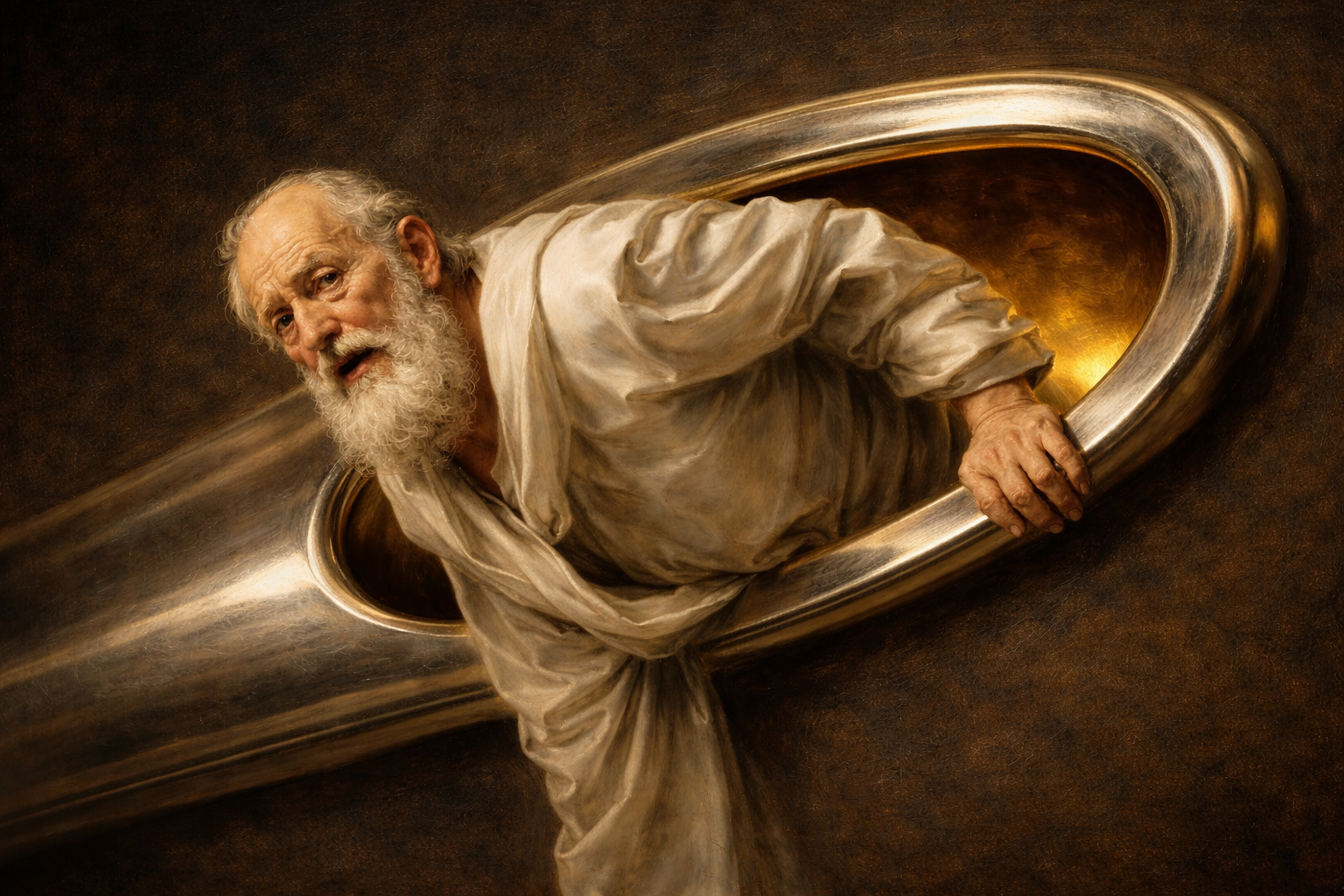
The Actus is the only loophole left for God. To Him, it is easier to go through the eye of a needle.
The figurative theory of Wittgenstein lacks a theory of Creation. Thus, he is also a philosopher of nature (not less metaphysical for that), like Democritus, Heraclitus, or Parmenides.
The «crazy symbol» comes from the 'family resemblance'. Come from the God of the Fathers.
If God ever ceased to be the 'God of the Fathers', it was because He entered through the hole that they possessed down the form of 'Actus', and that is true evangelization, not made by God, but directly by Man. Remember that God gave everything to Man. Abraham did do performed spiritual exercises.
Outside of language are the features and the «crazy symbol».
 This text appears to be a dense philosophical reflection combining theological, metaphysical, and linguistic elements. To analyze it, we will address several of its key components:
1. The Nature of Evil: The text begins by stating that evil is not a contingency, implying that it is a constant or necessity in the cosmos or human nature. The author suggests that this perspective on evil makes it essential to choose "your God" correctly. Here, "God" could be interpreted literally and metaphorically, referring to the fundamental principles or values one picks to follow.
2. Actus and God: The reference to "Actus" as the only "loophole" left for God, along with the metaphor of passing through "the eye of a needle," suggests a discussion on the limitation or rarity of direct divine intervention. "Actus" could refer to the pure act of existence or the reification of a potential in theological or philosophical terms. This concept might be exploring how God interacts with the world or the limitations of such interaction.
3. References to Philosophers and Theories: The mention of Wittgenstein and his "figurative theory" likely refers to his ideas about language and reality, specifically to the theory of "language games" and "family resemblance." The author criticizes Wittgenstein for not including a "theory of Creation," which suggests a lack of exploration in the relationship between language, creation, and the divine. The pre-Socratic philosophers mentioned (Democritus, Heraclitus, Parmenides) are also brought up to reinforce the idea that even thinkers focused on nature cannot escape metaphysics.
4. God and Evangelization: There is an intriguing idea that God, crossing through the "Actus," allows man to take an active role in evangelization or the propagation of faith, not as a divine act but as a human one. It reflects a theology where human autonomy and action are central.
5. Language, Features, and the 'Crazy Symbol': Finally, the text discusses how certain elements, such as features and the "crazy symbol," exist outside of language, interpreted as a reflection on how some realities or experiences are indescribable or ineffable within the limits of human language.
Overall, the text seems to be exploring the relationship between God, humanity, and evil, with a strong inclination towards issues of metaphysics, theology, and theories of language. It proposes that the essence and influence of the divine are less direct and more mediated by human existence and actions than some doctrines might suggest. Moreover, it criticizes some philosophical theories for not sufficiently incorporating spiritual or creative dimensions in understanding the world.
El ojo de la aguja-ii
Id: 591 Categoría: Dios y hombre Date: 2024-04-19 07:05:00
El problema es que la maldad no es ninguna contingencia, y por eso debes acertar con tu Dios. Y no porque no lo sea en el ser, sino porque no lo es en el superser.
El Actus es el único agujero que le queda a Dios. Más fácil es que pase por el ojo de una aguja.
A la teoría figurativa de Wittgenstein le falta la de Creación. Por eso es también un filósofo de la naturaleza (no menos metafísico por ello), como pudiese pasarle a Demócrito, Heráclito, o Parménides.
El Signo loco Proviene del «family resemblance»; del Dios de los Padres.
Si Dios dejó de ser alguna vez el «Dios de los Padres» fue porque entró por el agujero que estos poseían en forma de «Actus», y que es la verdadera evangelización, que no la hace Dios, la hace el Hombre directamente. Recordemos que Dios se lo dio todo al Hombre. Abraham sí hizo ejercicios espirituales.
Fuera del lenguaje están: los rasgos y el Signo Loco.
Este texto parece ser una reflexión densa y filosófica que combina elementos teológicos, metafísicos y lingüísticos. Para analizarlo, abordaremos varios de sus componentes clave:
1. La naturaleza de la maldad: El texto comienza declarando que la maldad no es una contingencia, implicando que es una constante o necesidad en el cosmos o en la naturaleza humana. El autor sugiere que esta perspectiva sobre la maldad hace esencial elegir correctamente a "tu Dios". Aquí, "Dios" podría interpretarse tanto literalmente como en un sentido metafórico que se refiere a los principios o valores fundamentales que uno elige seguir.
2. El Actus y Dios: La referencia al "Actus" como el único "agujero" que le queda a Dios, junto con la metáfora de pasar por "el ojo de una aguja", sugiere una discusión sobre la limitación o la rareza de la intervención divina directa. "Actus" podría referirse al acto puro de existencia o a la actualización de un potencial, en términos teológicos o filosóficos. Este concepto podría estar explorando cómo Dios interactúa con el mundo o las limitaciones de dicha interacción.
3. Referencias a filósofos y teorías: La mención de Wittgenstein y su "teoría figurativa" probablemente se refiere a sus ideas sobre el lenguaje y la realidad, específicamente a la teoría de los "juegos del lenguaje" y la "semejanza de familia" (family resemblance). El autor critica a Wittgenstein por no incluir una "teoría de la Creación", lo que sugiere una falta de exploración en la relación entre el lenguaje, la creación y lo divino. Los filósofos presocráticos mencionados (Demócrito, Heráclito, Parménides) también son traídos a colación para reforzar la idea de que incluso pensadores centrados en la naturaleza no pueden escapar de la metafísica.
4. Dios y la evangelización: Hay una idea intrigante de que Dios, al entrar a través del "Actus", permite que el hombre asuma un papel activo en la evangelización o propagación de la fe, no como un acto divino sino humano. Esto refleja una teología donde la autonomía humana y la acción son centrales.
5. Lenguaje, rasgos y el "signo loco": Finalmente, el texto toca cómo ciertos elementos, como los rasgos y el "signo loco", existen fuera del lenguaje, lo que podría interpretarse como una reflexión sobre cómo algunas realidades o experiencias son indescriptibles o inefables dentro de los límites del lenguaje humano.
En conjunto, el texto parece estar explorando la relación entre Dios, la humanidad, y la maldad, con una fuerte inclinación hacia cuestiones de metafísica, teología, y teorías del lenguaje. Propone que la esencia y la influencia de la divinidad son menos directas y más mediadas por la existencia y acciones humanas que lo que algunas doctrinas podrían sugerir. Además, critica ciertas teorías filosóficas por no incorporar suficientemente dimensiones espirituales o creativas en su comprensión del mundo.