Moral en acto o hecho
Explora la complejidad de la moralidad humana como un límite místico, donde la autoconciencia revela un juicio contingente sobre la Otredad y su relación con lo divino.
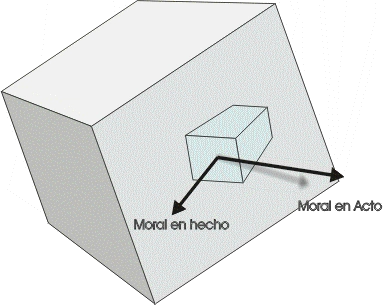
 Los hechos no contradicen las figuras lógicas: para el hombre todos los espacios lógicos son visibles. La autoconciencia crea el espacio lógico adecuado a su finalidad y la aplica al mundo y el mundo lo soporta. Dos espacios lógicos incompatibles conviven sin contradicción. La contradicción está dentro de la autoconciencia, no fuera, donde todo es tautología. Pretender que los hechos me den la razón absoluta es como pretender que una tautología soporte una contradicción, o sea que A=A=-A... Por eso, lo visible es ya Otredad en un tipo misterioso de manifestación visible.
El juicio no es un prototipo originario del conocimiento, sino que es secundario y derivado. Es el sustituto de la Intuición de Dios, que la metafísica racionalista había atribuido al conocimiento humano (Eusebi Colomer, Hist. Fil. Kant, pág.77 final).
El juzgar es el conocer en cuanto humano, pero no el conocer en cuanto conocer.
Nos hacemos figuras de los hechos (Witt.).
Solo desde la imagen no es posible conocer si es verdadera o falsa.
Las ciencias son lenguajes sobre la coherencia o estructura interna de las figuras de los hechos, pero no de coherencia o de estructura interna de los hechos. No hay un lenguaje así, porque sería generador de juicios sintéticos a priori; sería el lenguaje del conocimiento en cuanto conocimiento y, o bien coincidiría plenamente con la Intuición de Dios, o bien todo esto nada más quiere decir que Dios se esfuerza por aparecer en la forma de figuración del hombre, de donde emana su juicio personal. Una gozada; si ese lenguaje me permitiese decir que todos los romanos son malos, lo serían de verdad. En todo caso, un lenguaje lógico correcto no nos llevará nunca a un lenguaje así, sino solo a los límites del mundo. La diferencia es que una pretensión lleva al hombre hacia el salvajismo de la voluntad interior y el otro hacia la voluntad salvaje interior como morada de Dios (nuestros típicos antiproyectados y devinientes)…
Que la contingencia del hombre le da igual a Dios es cosa conocida. Que Dios sabe que hay hombres que lo entienden es revelación conocida. La verdadera paradoja del hombre es que tiene que negociar una moral que es un límite místico porque es un juicio contingente sobre figuras de hechos misteriosos. Ahí reside el principio de Humildad, que coincide en esto con el punto 7 de Wittgenstein. Hechos misteriosos porque ni siquiera la concordancia interna entre el hecho y la figura garantiza el conocimiento, sino que el conocimiento es el azar de Dios. Aquí podríamos decir que el hombre conoce por el conocimiento de Dios, que Dios le regala. Si hay Gracia, es ésta. Sí, podemos decir que Dios no ha bajado a la Tierra para hacer eso, sino que el hombre no abandonó nunca el seno divino, solo que ahora anda un poco contingente (algo así como estar un poco muerto: se puede estar un poco muerto, por ejemplo, estar vivo).
El límite místico de la moral es que es normal al plano del ser, en su devenir o en su antiproyección (a un antiproyectado eso le parece porque su Otredad, aunque la tiene aplanchetada sobre el plano del ser, él la ve como si así no estuviese, sino que fuese realmente trascendente). Todo se confabula en esta ilusión... el lenguaje el primero, que por desgracia es lo único que se puede hablar).
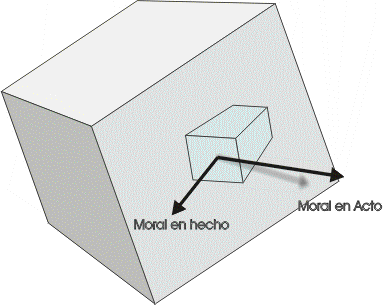
Este andar del conocimiento de Dios en la contingencia de la sensibilidad y el entendimiento depende del sentido y la dirección del vector resultante de una cosmología individual. Las cosmologías son todas posibles y conviven sin contradicción lógica ((porque el darse y no darse efectivos de estados de Verdad (no la lógica sino la Absoluta) conviven)), pero solo habrá algunas verdaderas, tomadas las cosmologías a su vez como objetos de la Otredad. Sería algo así como que las autoconciencias son capaces de ser el caso y no ser el caso trascendental, de modo que vivir en el plano del ser (valga la redundancia) es vivir en la contradicción pura, o sea, vivir en el espacio lógico de la Otredad. No puede ser de Otra manera, porque de lo que no se puede hablar, no ya es que haya que callar, sino que no se puede hablar. Esta es otra prueba de que la Verdad es proposicionable, y que las proposiciones de Verdad absoluta solo pueden hacerse sobre el hombre. Las cosmologías son figuras de las autoconciencias, que a su vez son figuras de los hechos trascendentales y misteriosos... que resumiendo mucho solo hay uno: que el hombre se hace Dios. Unas cosmologías serán súper-verdaderas (porque no es que tengan que ser coherentes como una figura de los hechos reales, sino de los súper-hechos, que son los hechos conectados el el Acto con la Ley profética a través de la figura lógica, que coincidirá por su forma con la figura lógica de un antiproyectado...etc), y otras súper-falsas, porque intentan que los súper-hechos coincidan con juicios sintéticos a priori (o sea que la Verdad sea una figura lógica de los hechos y que esto sea universal y necesario... cosas todas estas que son bastante moldeables a través de la gestión de la información y la complejidad)
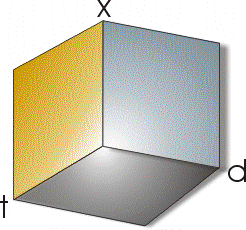
Hay cosas dadas necesarias para la multiplicidad y el momento, como la lógica. Son leyes sobre las posibilidades dadas en el momento y en la multiplicidad, tiempo y número, (t,x); x es el objeto lógico o la sustancia del mundo y a su vez el objeto y la sustancia del hecho Divino, sentido de la proposición profética (Devenir o lenguajear la realidad con la profecía), y t es el tiempo y a su vez el objeto del Devenir... En esta parte se usa objeto a la manera de Wittgenstein.
Quizás no pueda haber juicios sintéticos a priori\" salvo para la lógica convencional, si pensamos que la estricta necesidad y universalidad de este tipo de juicios es cosa baladí para la súper-lógica (lenguaje profético), ya que toda esa potencia de necesidad y universalidad son necesidades meramente lógicas, y se destruyen cuando este tipo de figuración cae en los ámbitos de la libertad salvaje interior (¿y qué si no lo hago?...). El único juicio sintético a priori que existe para la autoconciencia salvaje es la Ley profética en Acto, pero eso no se sabe ni cómo sucede, porque es una disposición del alma deviniente; y el que haga otra cosa, antiproyecta (por ejemplo usar las reglas lógicas para establecer proposiciones morales).
Si Dios deviniese como conocimiento antiproyectado llenaría el mundo de reglas morales, pero el hombre no es así. Que tenga una Libertad salvaje interior no es porque sea malo, sino porque deviene en Dios. Esa es la fe. La obediencia a la Ley profética y la fe están en la parábola del Centurión, que manda ir y van o venir y vienen. La fe en Dios y en el hombre son una misma cosa.
Dios deviene en la autoconciencia por interés: sabe que tiene que devenir y no quiere que nada se pierda, pero es como los bancos: quiere que, si el hombre puede, devenga solo. Si no, con haber creado a un solo hombre llamado multiplicidad sería bastante. Eso y no haber hecho nada es lo mismo, por lo menos para mí.
La discusión sobre la intuición Divina lo sería sobre el aparecer de los juicios sintéticos a priori al conocimiento. El negocio de Dios es el de los juicios sintéticos a priori: El hombre puede vivir como hombre con toda la tranquilidad de Dios, y puede vivir sin Dios y morir tranquilamente. Si quiere vivir como Dios, aunque sea a base de llamarse a sí mismo gusano, es cuando vienen los problemas. El más gordo el del sentido de la proposición.
Facts do not contradict logical figures: For man, all logical spaces are visible. Self-consciousness creates the logical space appropriate to its purpose and applies it to the world, and the world supports it. Two incompatible logical spaces coexist without contradiction. The contradiction lies within self-consciousness, not outside, where everything is a tautology. To pretend that the facts prove me absolutely right is like pretending that a tautology supports a contradiction, that is, that A=A=-A... That is why the visible is Already Otherness, in a Mysterious type of visible manifestation.
Judgment is not an original prototype of knowledge, but rather a secondary and derived one. It is the substitute for the intuition of God, which rationalist metaphysics had attributed to human knowledge ( Eusebi Colomer, Hist . Fil. Kant, p. 77 final).
Judging is knowing as human, but not knowing as knowing.
We make figures of the facts (Witt.).
From the image alone it is not possible to know whether it is true or false.
The sciences are languages about the coherence or internal structure of the figures of facts, but not about the coherence or internal structure of facts. There is no such language, because it would generate synthetic a priori judgments. It would be the language of knowledge as knowledge, and either it would coincide completely with the Intuition of God, or all this simply means that God strives to appear in the figurative form of man, from which his personal judgment emanates. A joy! If that language allowed me to say that all Romans are bad, they would truly be. In any case, a correct logical language will never lead us to such a language, but only to the limits of the world. The difference is that one pretension leads man toward the savagery of the inner will, and the other, toward the savage inner will as the dwelling place of God (our typical anti-projected and becoming)...
That the contingency of man is indifferent to God is a known fact (the same applies to Him). That God knows there are men who understand Him is a known Revelation. The true paradox of man is that he must negotiate a morality that is a mystical limit because it is a contingent judgment on figures of Mysterious facts. Therein lies the principle of Humility, which coincides in this with Wittgenstein's point 7. Mysterious Facts, because not even the internal concordance between the fact and the figure guarantees knowledge, but rather knowledge is the chance of God. Here we could say that man knows through the Knowledge of God, which the Superior Logos gifts to man. If Grace exists, it is this. Yes, we can say that God did not come down to Earth to do that, but that man never left the Divine bosom, only now he walks a little contingent (something like being a little dead: one can be a little dead, for example, while being alive).
The mystical limit of morality is that it is normal on the plane of being, in its becoming or in its anti-projection, (to an anti-projected person it seems that way, because his Otherness, although he has it brought down on the plane of being, he sees it as if it were not there, but rather were truly transcendent. Everything conspires in this illusion... language first, which unfortunately is the only thing that can be spoken).
*****
This journey of the knowledge of God in the contingency of sensitivity and understanding depends on the sense and direction of the vector resulting from an individual cosmology. Cosmologies are all possible and coexist without logical contradiction (because the actual givenness and non-givenness of states of Truth—not logic, but the Absolute—coexist), but only a few will be true, considering cosmologies in turn as objects of Otherness. It would be something like self-consciousnesses being capable of being the transcendental case and not being the transcendental case, such that living on the plane of being (excuse the redundancy) is living in pure contradiction, that is, living in the logical space of Otherness. It cannot be any other way, because what cannot be spoken about, not only must one remain silent, but also that one cannot speak about it. This is further proof that Truth is propositional, and that propositions of absolute Truth can only be made about humankind. Cosmologies are figures of self-consciousness, which in turn are figures of transcendental and mysterious facts... which, in short, there is only one: that man becomes God.
Some cosmologies will be super-true (because they do not have to be coherent as a figure of real facts, but of super-facts, which are the facts connected in the Act with the prophetic Law through the logical figure, which will coincide in form with the logical figure of an anti-projected, etc.), and others super-false, because they try to make the super-facts coincide with synthetic a priori judgments (that is, that the Truth is a logical figure of the facts and that this is universal and necessary... all these things are quite malleable through the management of information and complexity).
There are given things necessary for multiplicity and moment, such as logic. They are laws about the given possibilities in moment and in multiplicity, time and number, (t, x); "x" is the logical object or the substance of the world and in turn the object and substance of the Divine fact, meaning of the prophetic proposition (Becoming or languaging reality with prophecy), and "t" is time and in turn the object of Becoming... In this part, object is used in the manner of Wittgenstein.

Perhaps there can be no " synthetic a priori judgments" except for conventional logic, if we consider that the strict necessity and universality of this type of judgments is a trivial matter for superlogic (prophetic language), since all that power of necessity and universality are merely logical necessities, and they are destroyed when this type of figuration falls into the realms of inner savage freedom (so what if I don't do it?...). The only synthetic a priori judgment that exists for savage self-consciousness is the Prophetic Law in Act, but that is not even known how it happens, because it is a disposition of the becoming soul; and whoever does anything else, anti-projects (for example, using logical rules to establish moral propositions).
If God were to become anti-projected knowledge, he would fill the world with moral rules, but man is not like that. His having a savage inner freedom is not because he is evil, but because he becomes God. That is faith. Obedience to the prophetic Law and faith are found in the parable of the Centurion, who commands them to go and they go or to come and they come. Faith in God and in man are one and the same.
God becomes self-conscious out of self-interest. He knows he must become and doesn't want anything to be lost, but he's like banks: he wants man to become self-conscious, if possible. If not, having created a single man called multiplicity would be enough. That, and having done nothing, is the same thing, at least for me.
The discussion about Divine intuition would be about the appearance of synthetic a priori judgments to knowledge. God's business is that of synthetic a priori judgments: Man can live as man with all the tranquility of God, and he can live without God and die peacefully. If he wants to live like God, even if it means calling himself a worm, that's when problems arise. The most fat , the one with the meaning of the proposition .
 This text is a profound exploration of the relationship between logic, morality, self-awareness, and the figure of the Higher Logos in humankind's journey toward God. Let's break it down into its key aspects:
1. The logical status of morality and facts
- It is mentioned that "facts do not contradict logical figures," which implies that reality is not a closed structure of absolute truths, but a space where self-awareness projects its logical configurations without internal contradiction.
- This resonates with the idea that contradictions are not in reality itself, but in self-awareness, since "everything is a tautology."
- Morality, in this context, is a mystical limit, not a property of the facts themselves.
2. Judgment as a secondary form of knowledge
- It is emphasized that judgment is a substitute for the "Intuition of God," implying that human knowledge is derived, not original. This fits with the Kantian idea that human knowledge is a construction that operates on phenomena, not on the thing itself.
- "Judging is knowing as human, but not knowing as knowing" — this suggests that there is a dimension of knowledge that transcends the merely human operation of judgment.
3. The problem of language and representation
- Wittgenstein is quoted as saying: "We make figures out of facts." That is, human knowledge has no direct access to reality except through representations.
- Science, according to the text, does not describe facts in themselves, but rather coherent logical structures within a conceptual framework.
- The notion is introduced that a language capable of describing the internal structure of events would be equivalent to the "Intuition of God," or at least to an attempt by God to appear within human figuration.
4. God and contingency
- It is pointed out that "God does not care about the contingency of man" and that "God knows that there are men who understand him." This suggests a vision in which God does not intervene in the world in a deterministic manner, but does recognize those who grasp his logic.
- The paradox of man is that his morality is a "contingent judgment on figures of mysterious facts." Here, a powerful idea emerges: morality is not a system of fixed rules, but an attempt to approximate something beyond formal logic.
5. Cosmologies and superfacts
- The notion is introduced that all cosmologies are possible and coexist without contradiction, but that only some are "true" when taken as objects within Otherness.
- The possibility of "supertruths" and "superfalsehoods" is mentioned, depending on whether they align with the Prophetic Law or attempt to construct a universal system based on synthetic a priori judgments.
- It is emphasized that logic is a set of rules about possibilities in time and multiplicity, but it is not the absolute language of knowledge.
6. The synthetic a priori judgment and the prophetic law
- It is argued that the only truly valid form of synthetic a priori judgment is that given in the "Prophetic Law in Act."
- Here there seems to be a criticism of formal logic as the sole criterion of truth, suggesting that the Prophetic Law introduces a form of knowledge that transcends conventional logic.
7. God and faith as becoming
- It is said that "God becomes self-consciousness through interest," which reinforces the idea that God is not a static entity, but a process that takes place in the existence of man.
- Faith is presented as an act of trust in that future, and the parable of the Centurion is mentioned as a model of operative faith.
8. The problem of the meaning of the proposition
- It is suggested that the real problem is the meaning of the moral proposition and its relation to existence.
- The text concludes by stating that "God's business is that of synthetic a priori judgments," implying that the ultimate question is not logical or ethical in a human sense, but rather something that is played out in the realm of divine development.
Conclusion
This text moves at the intersection of logic, morality, theology, and epistemology. It argues that morality is not an objective construct based on facts, but a mystical boundary where the contingency of human judgment confronts the Mysterious. God does not impose moral rules; rather, his becoming allows humankind to discover the prophetic Law in Action.
The central issue is not whether morality is objective or subjective, but rather what meaning it has within a cosmology where man and God are part of the same process of becoming. Faith, in this context, is not an unfounded belief, but rather the trust that the Higher Logos guides the existence of self-consciousness.
This approach is reminiscent of certain aspects of Wittgenstein's "Tractatus," Heidegger's phenomenology in "Being and Time," and Kantian transcendental idealism, but reconfigured in a becoming cosmology where logic is not the ultimate end, but a limit within which the relationship between man and God is played out.
It is a dense text, but it addresses a key question: to what extent is moral truth something that can be formulated in logical terms, and to what extent is it simply the manifestation of a divine becoming